Buffets are really a bad thing... I feel like we've been eating like animals at a feed lot for our daily breakfasts and some of the other meals that are included with the tour. In fact, it has been a bit difficult to get out and about to sample some of the local cuisine lately because of the scheduling of meals on the tour, but most of the food has been good nonetheless. I'm definitely feeling my body get softer and more plump...
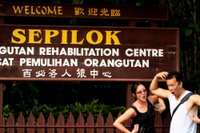 Speaking of feeding, today we were looking forward to one of the big highlights of the trip: a visit to the Sepilok Orang-Utang Rehabilitation center, where injured, abandoned orangutans are rehabilitated and gradually reintegrated back into the jungle. Orang-Utang is actually a Malay word translating to "Man (Orang) of the Forest (Utang)." Interestingly, they exist in only two areas of the world- here in the jungles of Sabah, and also in the jungles of Indonesia. Here are the first Orangutans we saw of the day.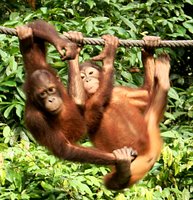
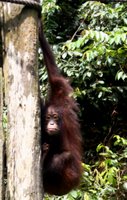
 The center does some amazing work and nurtures the orphaned animals, many from infancy until they are ready to be introduced into the jungle again. We were escorted to one of the feeding stations with a lookout point, and at once we saw some of the orangutangs sitting in the trees, hanging on the ropes and just chilling on the platforms. They seemed to know exactly when they would be getting their food because as soon as the caretaker showed up with buckets of milk, string beans, and bananas, orangutangs appeared out of nowhere, hurriedly making their way to the platform. We were able to get some good shots of these guys chowing down. It reminded me of us at the buffet this morning.
  All in all, our guide told us that it was a good day for the Orangutang viewing- we were able to see 12 in all, and one of the young dominant males even came down from the feeding station to roam around on the viewing platform. We all made sure to keep our distance, since we were told that they are very inquisitive animals and if you're a guy, you especially need to be careful and not to wear baggy shorts because orangutangs like to "reach for the fruit between the branches."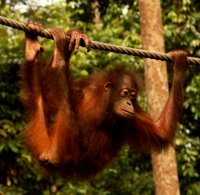
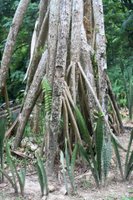
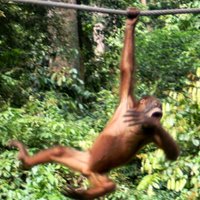 We bid farewell to these playful creatures and headed back to our hotel for lunch before embarking on a short tour of the area. First we headed to the house of Agnes Keith, an American woman who lived in the town of Sandakan (on the far eastern tip of Sabah) in the 1940's- 1960's. She actually attended UC Berkeley for college! She was in Borneo as the wife of the first administrator of forest conservation, but ended up making her own claim to fame by writing some really witty books about her time living in the jungle, and adjusting to life among the natives. The house itself seemed like a quaint English style home, but set smack in the middle of the rainforest. Jack thought that the roots of this tree were more interesting than the house:
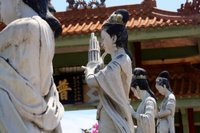
 From there, we headed to a massive Chinese Buddhist/Taoist temple, set high up on the hill. There were tributes to the Buddha of the past, present and future, as well as to the Goddess of Mercy, and small shrines set up in honor of passed ancestors. The view from the temple overlooked the South China Sea.
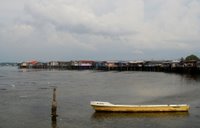
  Our last stop for the tour was a rudimentary water village built on stilts over the sea. We were led through a maze of small pathways fashioned out of logs and ended up at an open air cafe which offered amazing views of the colorful village in both directions. With it being lowtide, we saw people in the far distance of the sea, appearing to walk on water, as they waded ankle deep, looking for fish. It was so interesting to see the lifetyles of these people, living as they have for hundreds of years, mainly as fishermen, and then to see the children come home from school, yelling "hello!" as they made their way through the small pathways to their hut.
 We ended up back at our charming hotel at around 5pm, just in time for the hour long massage I'd booked for less than 30 bucks. It was ok. My relaxation was somewhat shattered when the masseuse's cell phone rang towards the end of the session with this really annoying ring: "You have a call! You have a call! etc..." Said in a baby voice. Lovely.
For dinner, we joined the group and ate a great seafood joint. The night was made all the more exciting by the flash lightning and thunder storm which we were able to experience quite fully since we were eating OUTSIDE under a canopied awning. Not much conversation since the drumming of the rain on the tin roofs drowned out all other sounds.


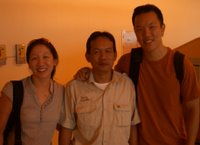 Well, our incredible time in Sarawak has finally come to an end, and we're off to new adventures in the state of Sabah. It was time also to bid farewell to Rives, our trusty local guide, who we'd grown to really enjoy and appreciate. We'll miss his knowledge, his genuine friendliness, and the corny but endearing jokes he used to tell to start off the days... Example: When I asked him what he thought of Singapore, he replied, "We call Singapore a very fine city... whatever you do, you get a fine." He really was a great guide. Rives, if you're reading this, you are AWESOME!
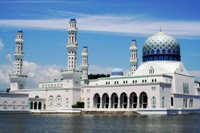
 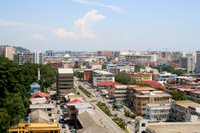 The second mosque is the city mosque, which is second in size only to the state mosque in another part of town. It was pretty impressive... a gleaming white building surrounded by water. From the roadside, we could hear chanting, which we were told was a reading of the Koran. KK is primarily Christian, but the mosques were built by the government (Malaysia is a Muslim country) to serve the local Muslim population.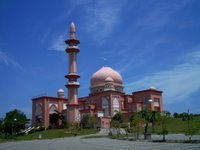
 We headed back to the airport to catch our flight to Sandakan, but unfortunately the flight was delayed. Perhaps even more unfortunately, the air conditioning at the airport wasn't working, so we were treated to a free "sauna" while we waited for our plane to arrive. At last, we boarded and took a short 45 minute flight to our final destination. We were rewarded for our wait with this beautiful view of Mount Kinabalu from the airplane and a fantastic hotel at the other end. Time to rest for a day of orangutans tomorrow!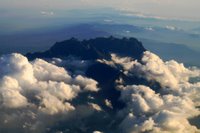
 We also visited a palm oil processing plant, another leading Malaysian industry. Palm oil is compressed from the fruit of a certain type of palm, and the oil is used in everything from cooking food, to makeup to potentially biodiesel fuel.
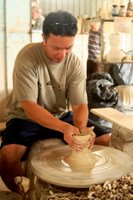
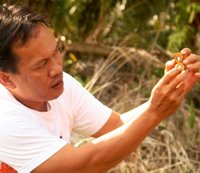 Yet another stop brought us to a pottery place, where native artists create and sell their work. Jack took a stab at the pottery wheel and actually did pretty well until I demanded a tall, skinny vase, at which point the whole thing imploded and he was left with a short stump of clay.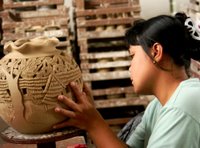
 We finally made it back to Kuching by 4pm and had the rest of the evening to relax and enjoy the city one last night. Our guide Thomas told us about the Sunday market, a vast, open air market lasting from 12 noon on Saturday until 12 noon on Sunday. We hired a cab for 8 ringgits (less than 3 bucks) which tooks us to the little maze of streets that consists the market. We immediately headed to the food aisle, an intense and crowded array of food stalls serving different types of curries, fried noodles, soup and satays. For dinner, we settled on mee sup (chicken noodle soup Malaysian style) and some chicken and beef satay, which were about 30 ringgit cents apiece (less than 10 cents!)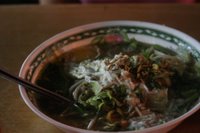
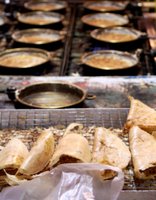
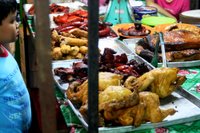 The heat of the cooking food and the increasing crowds drove us to eat quickly and move on, so we headed to the vendors, which once again, sold everything from woven baskets, to dried fish to door hinges! Definitely a fun place to hang out and I imagine that it only became more crowded as the night wore on.
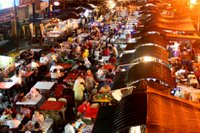 We were back at the hotel by 10 pm to get ready for the next day, a full day of travel to reach Sandakan, a town in the neighboring state of Sabah, on the eastern coast of Borneo.
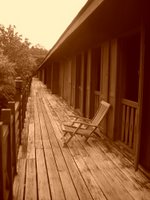 Our day began with yet another buffet breakfast at the hotel. The veranda to the dining room opened up to a spectacular view of the reservoir, and after fueling up for the morning, we strolled the lush gardens of the hotel grounds. The Hilton Batang Ai is built in the style of a longhouse, which is the traditional form of shelter for many of the indigenous tribes in Borneo. It is as it sounds- one really long house, with multiple rooms opening up into a wide, common corridor. As many as hundreds of people can live in one longhouse, and most of them will be related.
 At 9 am, we headed down to the jetty, where we had arrived at the hotel by boat the day before, and were picked up in motorized longboats by residents of an Iban tribe longhouse that we would be visiting later today. We had a peaceful ride through the morning mist, gliding low on the glassy water. Our guides reminded us to balance ourselves in the narrow boat, and assured us that the crocodiles that lived in the reservoir were strict vegetarians. Fabulous.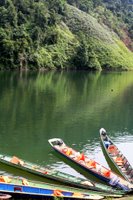
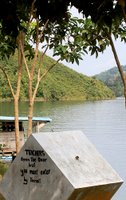 Our first stop was at a village school on an island in the reservoir about 40 minutes away. The school housed students in the primary grades from neighboring longhouses, as well as students from villages as far away as a 10 hour boat ride. As we pulled up to the school’s jetty, we could here the cheers of the children as they ran out to the docks to greet us, some of them waving from the windows of their classrooms. We brought with us some pencils and note books as gifts for the school, and had the opportunity to tour the school grounds and hang out with the kids. They were so amazing!

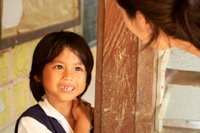 All of the students board at the school in simple dormitories, and children as young as 6 years old were able to groom themselves, do their own laundry and communicate with us articulately in English. Some of the little girls fell in love with Jack and followed us as we went from one classroom to another, calling his name and saying hello.
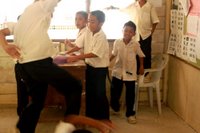
 Some of the older boys we met entertained us with a song when I asked, and sang a very spirited, rhythmic version of a song I soon identified as “10 Little Fingers.” They even did a little breakdancing! It was such a treat to see this charming school with the beautiful students in such an idyllic setting. Education is a top priority for the Malaysian government and the rate of students who go on to university grows higher each year.
 Our next stop was a traditional longhouse about 10 minutes further down the reservoir, and the residents welcomed us into their home with hot Chinese tea, home-brewed rice wine (very ricey with a tart aftertaste) and warm smiles.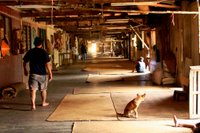
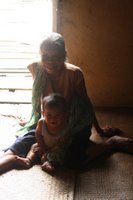 They brought out traditional tribal instruments, which looked similar to the Indonesian gongs and gamelans, and performed several Iban dances in their traditional dress. The headman of the longhouse welcomed us into his room and proudly showed us pictures of his daughters, two of whom had graduated from the university and were now working in the city.
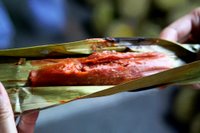
 For lunch, they served us a home-cooked meal of sticky rice wrapped in a large leaf, chicken steamed in bamboo cookware, okra and fresh fruit. All of the residents were so kind and gentle and when it was time for us to leave, they pulled up their longboats and quietly took us back to our hotel on the other side of the reservoir.
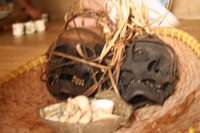 It was 2pm by the time we got back, but with the intense heat and humidity, we decided to rest in the room for a bit before heading out to cool off at the pool. That night, the hotel hosted a great barbeque and we ate outside on the veranda while enjoying a spectacular sunset.
 After dinner, we met up with our guide Thomas for a beer by the poolside, and learned some interesting facts about this gentle, cheerful man whom we’ve come to trust so much in just a few days. He works so hard to ensure our safety and comfort in this trip, and it is apparent that he loves his work and has a lot of pride for his country. He himself was actually born in a longhouse, grew up in the jungle and often leads intense jungle-trekking, mountain-climbing, cave-exploring expeditions for travelers seeking adventure and intrigue. He told us some hilarious stories of past experiences guiding, as well as more personal stories about his family and his hopes for his children. Our evening with him under the stars was yet another example of the warm and gentle nature of the native people.
 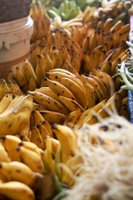 The drive to Batang Ai is about 5 hours long, so we stopped along the way to check out one of the bigger produce street markets. Man, Berkeley Bowl has nothing on these guys… there was so much fruit and produce around, some familiar, some that we’d never seen before, and all of it beautiful.
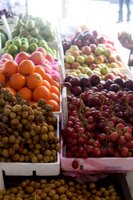 Malaysia is truly blessed with some pretty amazing fruit.
 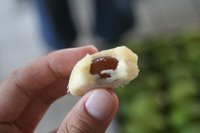 Thomas showed us this really interesting fruit called the snake fruit. It has a thin, dry outer skin that has a leathery, brown snake-like pattern. But peel away the shell and you get several distinct lobes with semi-fibrous, pale flesh. The fruit is not quite juicy, but close, and it has this fantastic tropical fruit, fresh citrus flavor. Delicious!
 Fish is definitely a big deal in Malaysia. Here are several different types of dried anchovies.
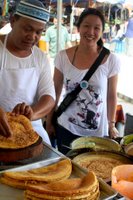 The street vendors were also selling some hot foods. Here is La Verne with a street vendor who made us a crepe/pancake filled peanuts and a little sugar and butter. Even though the day was already getting quite warm, the hot crepe (right off the griddle) was so good! I think the food here is one of the things that I like the best; there is a real appreciation for ingredients, and freshness is so important because of the amount of heat in the area and the somewhat limited amount of refrigeration available in the rural areas. You get to see how people get by without the conveniences we take for granted.
 About an hour later, our bus stopped along the side of the road so we could see a little patch of wild orchids. They were small, but really quite nice; a treat for orchid lovers.
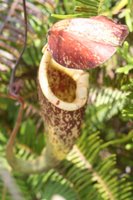 They also had some funky/exotic other plants, like this one: the Pitcher Plant. It’s a carnivorous plant that traps insects in a sticky pool of fluid inside its “pitcher”, then slowly digests them for nutrition. Yum.
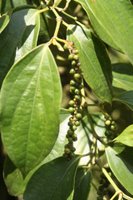 The third stop along the way was at a pepper farm. Peppercorns are an important export for Malaysia, although pepper farms are beginning to give way to palm oil plantations because of the higher profitability of palm oil. Malaysians are quite proud of their pepper, and feel it is the best in the world. The pepper berries are smaller than those grown in other countries, so the heat is really concentrated once the peppercorns are dried. Sounds kind of similar to grapes. La Verne took one and chewed on it... she looked like she needed a glass of water.
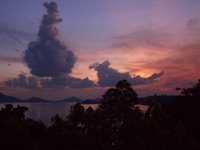 Somehow, Hilton got the exclusive rights to build a luxury resort on an island in this reservoir. The setting was pretty phenomenal… utterly peaceful. Here is a view of dusk over the reservoir from the hotel. We relaxed by the pool and called it a night fairly early… tomorrow will be a full day visiting an authentic longhouse!